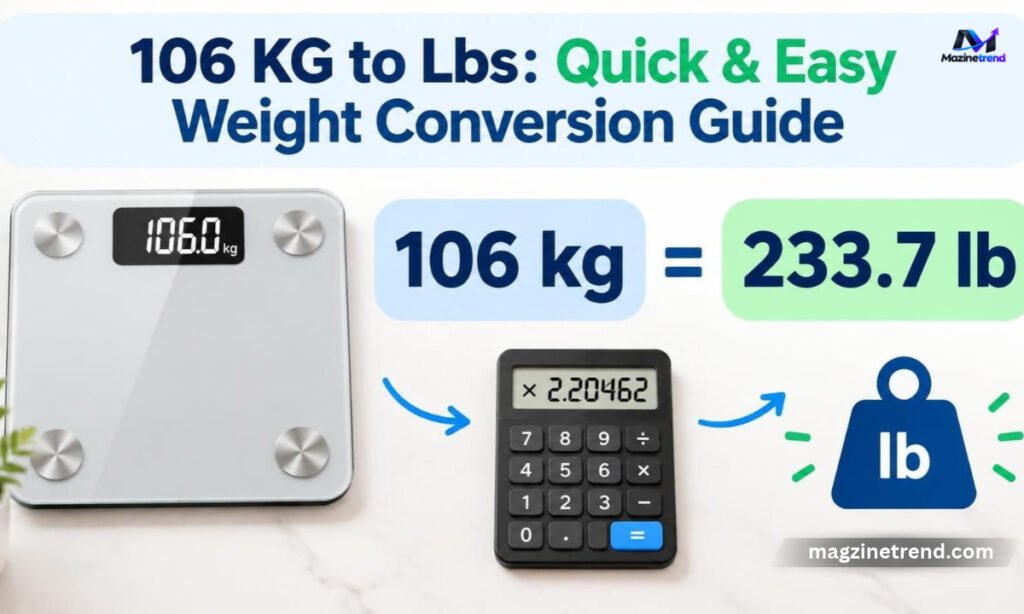
You are standing at a gym scale in Europe, filling out a US medical form, or looking at a shipping label, and you need to know what 106 kilograms means in pounds. Maybe a doctor mentioned a weight in kilos and you want to know what that looks like in the units you grew up with. Maybe you are trying to work out whether 106 kg is a “big” number at all.
Here is the quick answer.
106 kg = 233.69 lbs (about 233.7 pounds)
106 kg = 16 stone 9.7 pounds (UK)
106 kg = 233 pounds 11 ounces
The rest of this guide shows how that number is worked out, how to do it in your head, and what 106 kg means for your health at different heights.
Is 106 kg Overweight?
It depends on your height, your build, and how much of your weight is muscle.
For most adults, 106 kg falls in the overweight or obese range on the BMI scale. For a person who is 1.90 m (6 ft 3 in) tall, it is just under the obesity line. For a person who is 1.65 m (5 ft 5 in), it is well above it.
BMI is a screening tool, not a verdict. A rugby prop or a powerlifter can weigh 106 kg and carry very little body fat. Someone with a desk job and the same weight may have more health risk. So treat the BMI number as a starting point for a conversation with your doctor, not a final answer.
You will find the height-by-height numbers further down.
Read More:155 Pounds to KG: Quick & Easy Conversion Guide
106 KG to Lbs
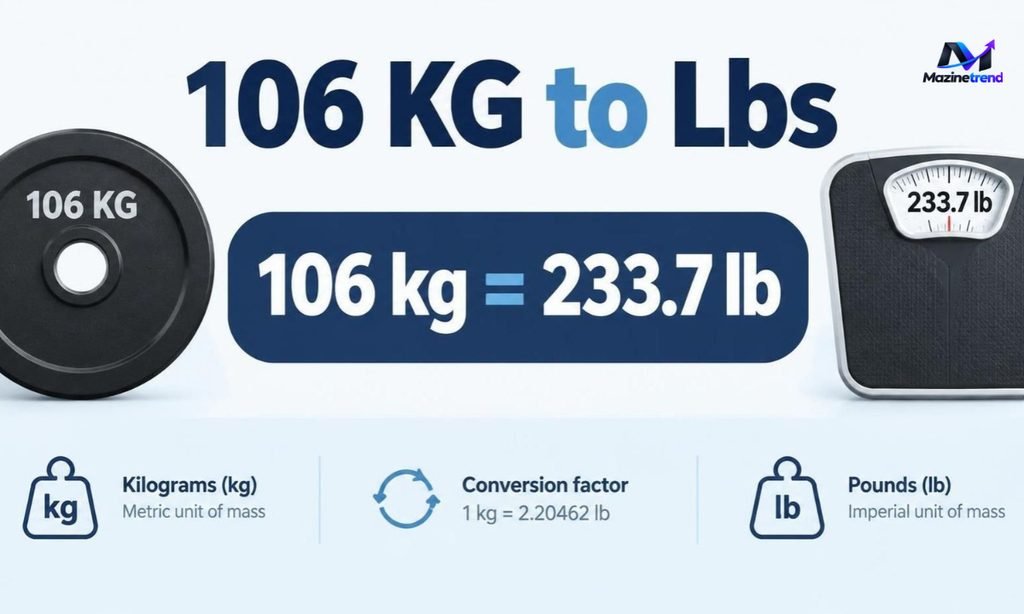
The conversion factor is simple:
1 kilogram = 2.20462262 pounds
So the formula is:
pounds = kilograms × 2.20462262
For 106 kg:
106 × 2.20462262 = 233.69 lbs
Most people round this to 233.7 pounds. If you are filling out a form that wants a whole number, write 234 lbs.
You can also go the other way. One pound is exactly 0.45359237 kg. So if someone gives you a weight of 233.7 lbs to kg, multiply 233.7 by 0.45359237 and you get about 106.0 kg.
Quick Mental Math for 106 kg in Pounds
You do not always have a calculator handy. Try this shortcut:
- Double the kilograms: 106 × 2 = 212
- Take 10% of the kilograms: 10.6
- Add them together: 212 + 10.6 = 222.6
- Add a little extra, about 11 more: roughly 233
It lands within a pound or two of the exact answer, which is fine for casual use.
BMI Context for 106 kg
BMI is your weight in kilograms divided by your height in meters squared. The adult categories used by the World Health Organization and the CDC are:
- Under 18.5: underweight
- 18.5 to 24.9: healthy range
- 25 to 29.9: overweight
- 30 to 34.9: obesity class 1
- 35 to 39.9: obesity class 2
- 40 and above: obesity class 3
At 106 kg, almost everyone under 2 meters tall will be in the overweight range or higher. The table in the next sections shows exactly where.
108 kg in Lbs Is Just Above 17 Stone
If you are checking nearby weights, 108 kg is 238.10 pounds. That is just above 17 stone (238 pounds). So if your scale reads a couple of kilos more than 106, you are crossing a round stone number, which can feel like a milestone for UK readers.
106 kg to Lbs and Stone
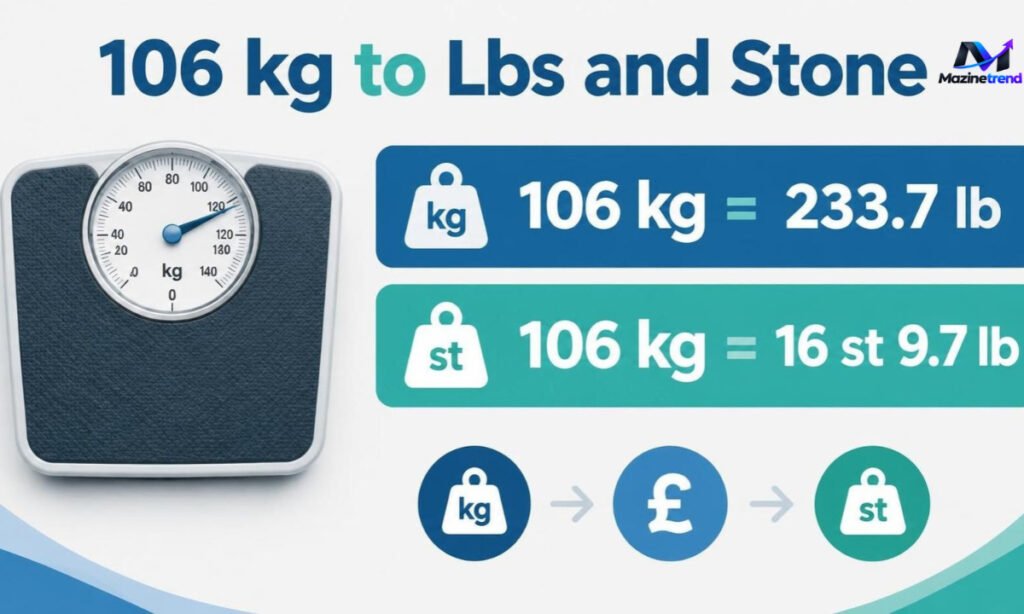
In the UK, weight is often given in stone and pounds. One stone is 14 pounds, or about 6.35 kg.
Here is how 106 kg works out:
- 233.69 pounds ÷ 14 = 16.69 stone
- 16 stone is 224 pounds
- 233.69 − 224 = 9.69 pounds
So 106 kg is 16 stone 9.7 pounds.
If you want to go in reverse, 16 stone 10 pounds is 234 pounds, which equals 106.14 kg. That is very close to 106 kg, so the two are nearly the same weight.
Some fitness apps use decimal stone, which would show this as 16.69 st. That is not the same as 16 stone 69 pounds, so be careful when reading it. The number after the decimal point is a fraction of a stone, not a count of pounds.
Is 106 kg a Healthy Weight? BMI by Height
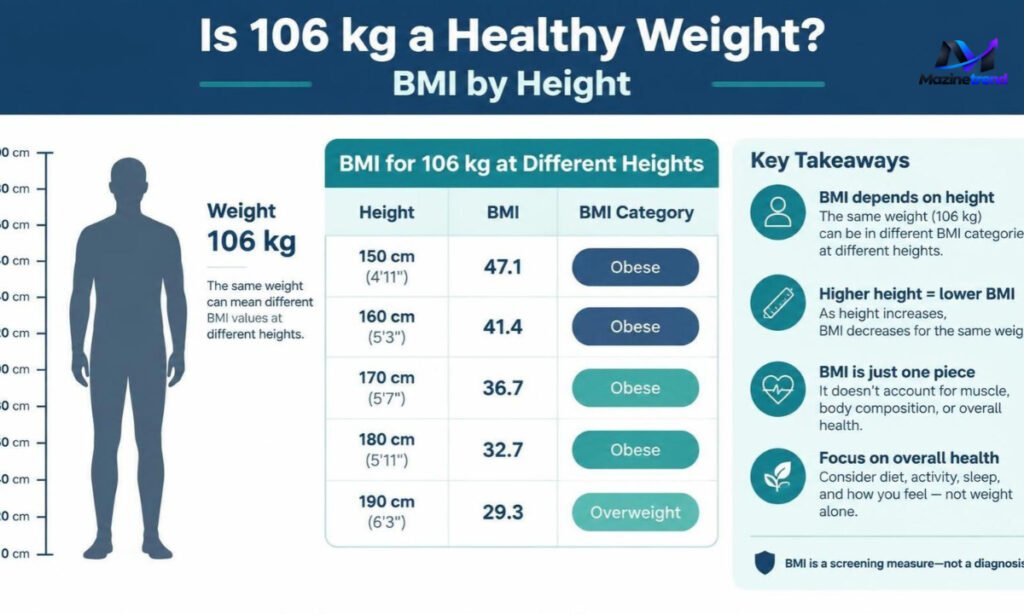
Here is the BMI for 106 kg at different heights. The numbers are rounded to one decimal.
| Height (cm) | Height (ft/in) | BMI at 106 kg | Category |
| 160 | 5 ft 3 in | 41.4 | Obesity class 3 |
| 165 | 5 ft 5 in | 38.9 | Obesity class 2 |
| 170 | 5 ft 7 in | 36.7 | Obesity class 2 |
| 175 | 5 ft 9 in | 34.6 | Obesity class 1 |
| 180 | 5 ft 11 in | 32.7 | Obesity class 1 |
| 185 | 6 ft 1 in | 31.0 | Obesity class 1 |
| 190 | 6 ft 3 in | 29.4 | Overweight |
| 195 | 6 ft 5 in | 27.9 | Overweight |
| 200 | 6 ft 7 in | 26.5 | Overweight |
A few things stand out. Someone around 5 ft 9 in (175 cm) who weighs 106 kg has a BMI of 34.6. Someone who is 6 ft 3 in (190 cm) at the same weight sits at 29.4, just under the obesity line.
Height changes the picture a lot. Two people can both weigh 106 kg and have very different health profiles.
Things BMI misses:
- How much of your weight is muscle versus fat
- Where you carry fat (belly fat is a bigger health concern than hip or thigh fat)
- Your age, sex, and ethnic background
- Your blood pressure, blood sugar, and cholesterol
A better picture comes from combining BMI with your waist measurement and a blood test. A waist above 102 cm (40 in) for men or 88 cm (35 in) for women is often flagged as higher risk. A doctor or nurse can walk you through your own numbers.
106.5 kg to Lbs
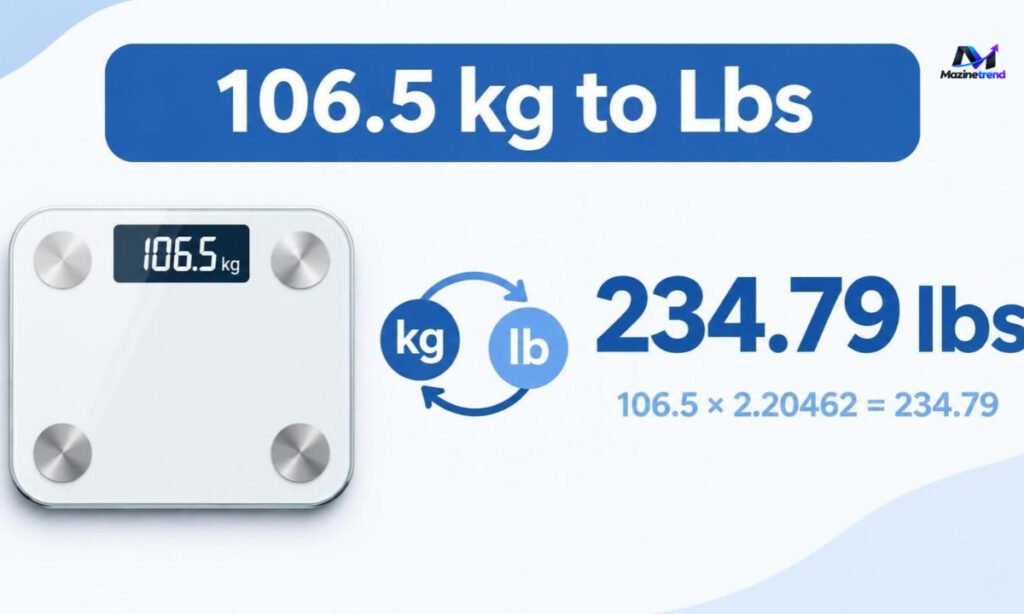
Digital scales often show half-kilo steps, so 106.5 kg comes up a lot.
106.5 × 2.20462262 = 234.79 lbs
In stone, that is 16 stone 10.8 pounds. So 106.5 kg is almost exactly 16 stone 11 pounds.
Weights Close to 106 kg
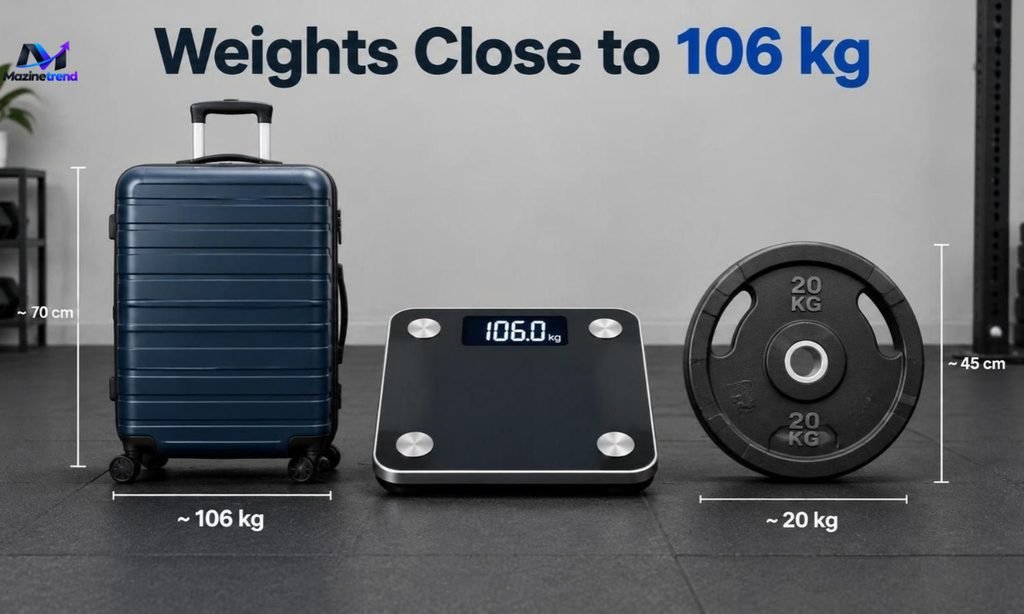
If your scale reads a bit higher or lower, this chart covers the neighborhood. Pounds are rounded to two decimals.
| Kilograms | Pounds | Stone and pounds |
| 100 kg | 220.46 lbs | 15 st 10.5 lb |
| 101 kg | 222.67 lbs | 15 st 12.7 lb |
| 102 kg | 224.87 lbs | 16 st 0.9 lb |
| 103 kg | 227.08 lbs | 16 st 3.1 lb |
| 104 kg | 229.28 lbs | 16 st 5.3 lb |
| 105 kg | 231.49 lbs | 16 st 7.5 lb |
| 106 kg | 233.69 lbs | 16 st 9.7 lb |
| 107 kg | 235.89 lbs | 16 st 11.9 lb |
| 108 kg | 238.10 lbs | 17 st 0.1 lb |
| 109 kg | 240.30 lbs | 17 st 2.3 lb |
| 110 kg | 242.51 lbs | 17 st 4.5 lb |
Each extra kilo adds about 2.2 pounds. That is a handy rule if you are tracking small changes.
106 kg to Lbs Weight in Everyday Terms
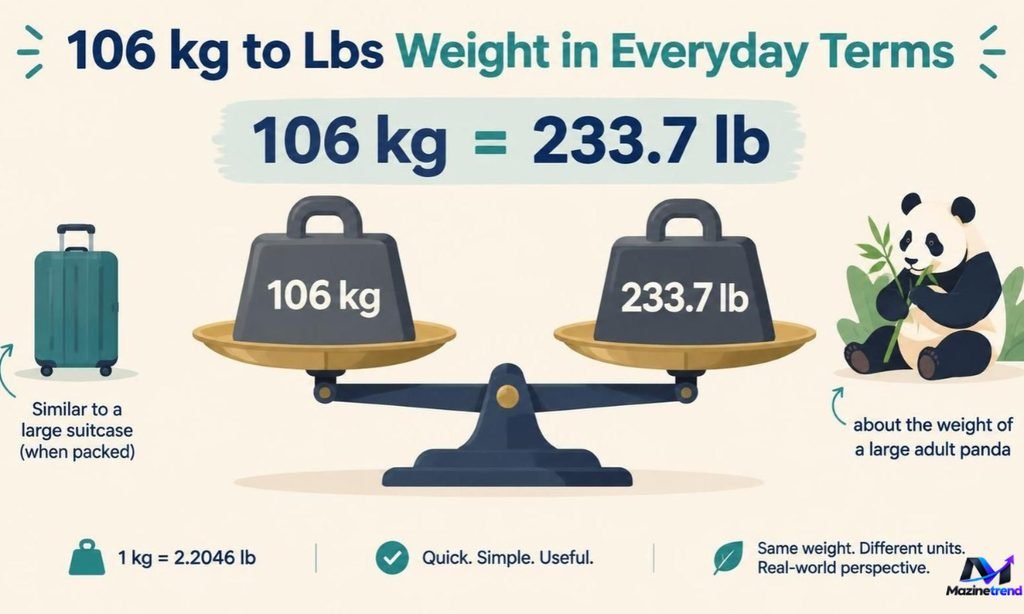
Numbers can feel abstract, so here is what 106 kg (233.7 lbs) looks like in real life:
- About the weight of a large adult male lion
- Around 13 to 14 bowling balls (a standard 16-pound ball)
- Roughly three and a half average 5-year-old children
- A bit more than a full-size adult male gorilla’s lower range
These comparisons are approximate, but they help when you are trying to picture how much weight you are lifting at the gym, shipping in a box, or carrying on a scale.
For gym use, 106 kg on a barbell is a solid number. In pounds, that is 233.7 lbs, which is close to the 235 lb mark many lifters aim for with a bar and plates.
Related Conversions Worth Bookmarking
If you work with weights often, these are the conversions most people need next.
KG to Pounds Converter
For any kilogram value, multiply by 2.20462. If you do this often, save a converter on your phone’s home screen, or use the calculator app and type the number followed by × 2.20462.
KG to Stone
Divide pounds by 14. For kilograms, divide by 6.35029. For 106 kg, that is 106 ÷ 6.35029 = 16.69 stone.
Pounds to Stone
Divide pounds by 14. The whole number is the stone. Multiply the leftover decimal by 14 to get the remaining pounds. For example, 234 lbs ÷ 14 = 16.71, and 0.71 × 14 is about 10, so 16 stone 10 pounds.
What Is LBS?
“Lbs” is the short form of pounds. It comes from the Latin word libra, which means scale or balance. One pound equals 16 ounces. The pound is used for body weight in the United States, and in the UK it is used alongside stone.
BMI Calculator
You can calculate BMI by hand with weight in kilograms divided by height in meters squared. If you use pounds and inches, use this version: BMI = (pounds × 703) ÷ inches squared. For 233.7 lbs at 70 inches, that is (233.7 × 703) ÷ 4,900 = 33.5.
106 kg to Lbs and Oz
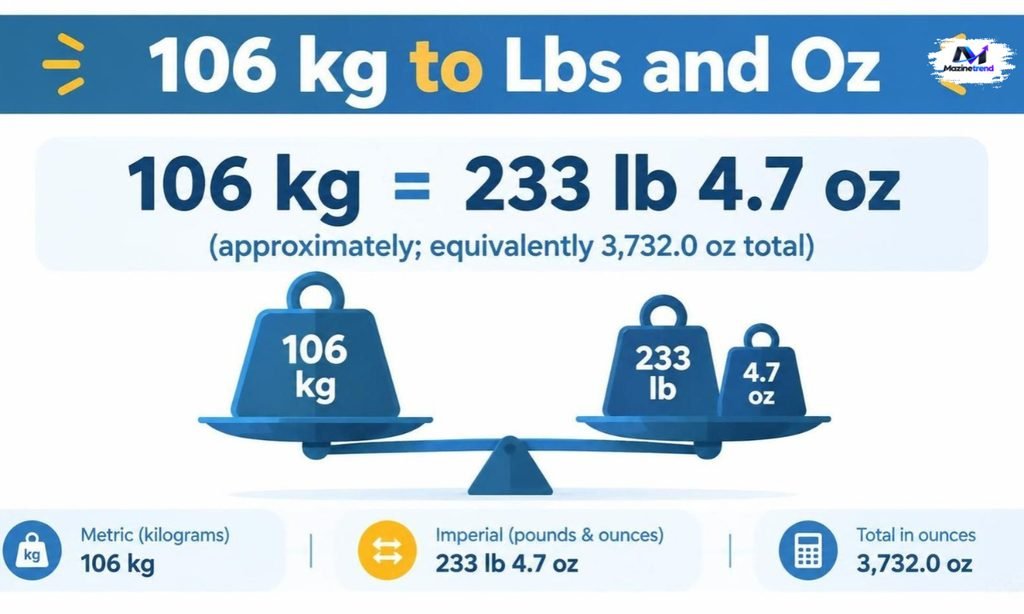
Sometimes you need ounces, for example when weighing luggage or filling in a form that wants pounds and ounces.
- 106 kg = 233.69 pounds
- The decimal part, 0.69 pounds, times 16 ounces = 11.04 ounces
So 106 kg is 233 pounds 11 ounces.
In total ounces, that is 233.69 × 16 = about 3,739 ounces.
Quick Formulas You Can Use Anywhere
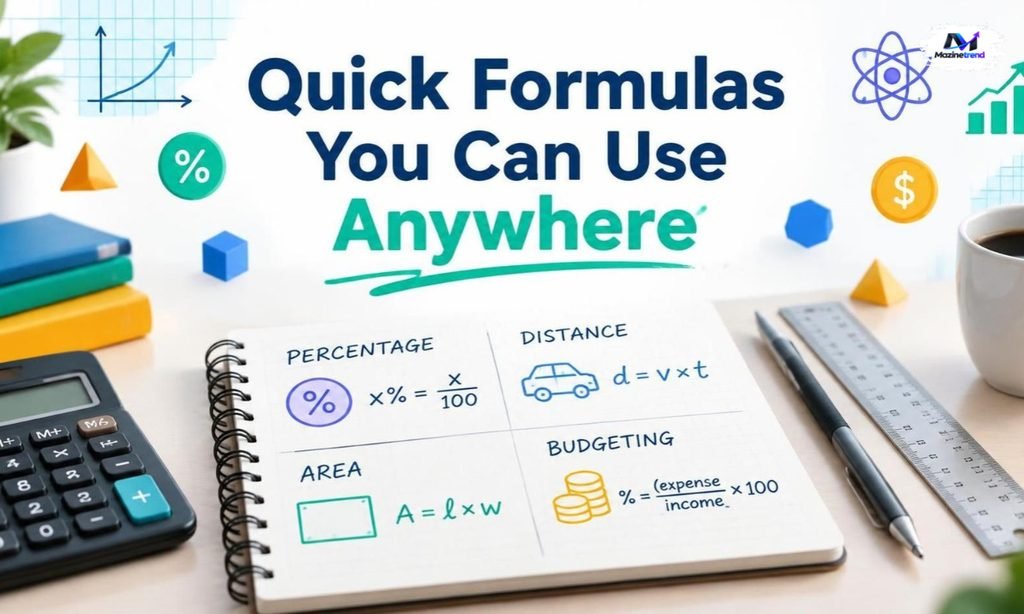
Here are the formulas on one list so you can screenshot them.
- Kilograms to pounds: multiply by 2.20462
- Pounds to kilograms: multiply by 0.45359 (or divide by 2.20462)
- Kilograms to stone: divide by 6.35029
- Stone to kilograms: multiply by 6.35029
- Pounds to stone: divide by 14
- Pounds to ounces: multiply by 16
A tip for avoiding mistakes: if you are going from kilograms to pounds, your answer should always be bigger than what you started with. If it is smaller, you probably divided when you should have multiplied.
106 kg to Stone
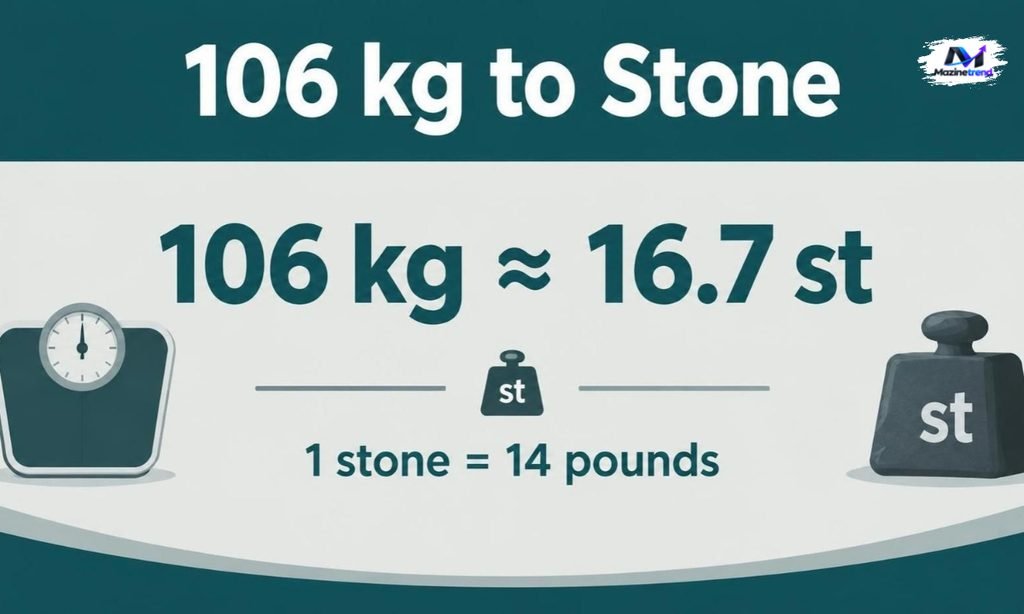
We covered this above, but here is the short version for anyone who scrolled straight to it:
106 kg = 16.69 stone = 16 stone 9.7 pounds
For UK forms, GP appointments, and weight-loss clubs, 16 stone 10 pounds is the usual rounded figure.
Reference and Guides: Kilograms to Pounds Chart
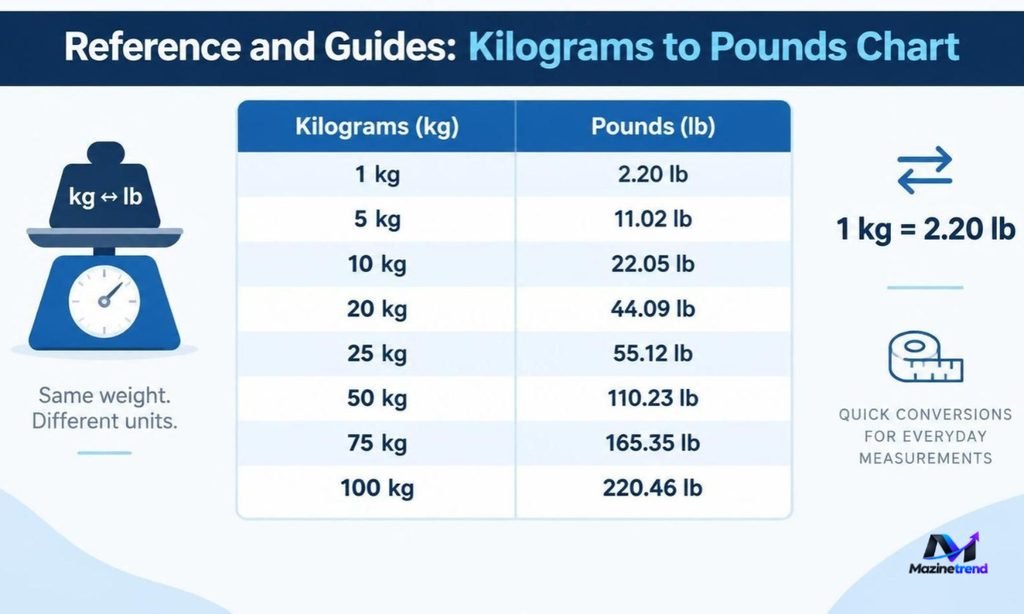
This chart goes beyond 106 and helps if you are tracking a weight loss or gain across a wider range.
| Kilograms | Pounds |
| 90 kg | 198.42 lbs |
| 95 kg | 209.44 lbs |
| 100 kg | 220.46 lbs |
| 105 kg | 231.49 lbs |
| 106 kg | 233.69 lbs |
| 110 kg | 242.51 lbs |
| 115 kg | 253.53 lbs |
| 120 kg | 264.55 lbs |
105 kg to Lbs
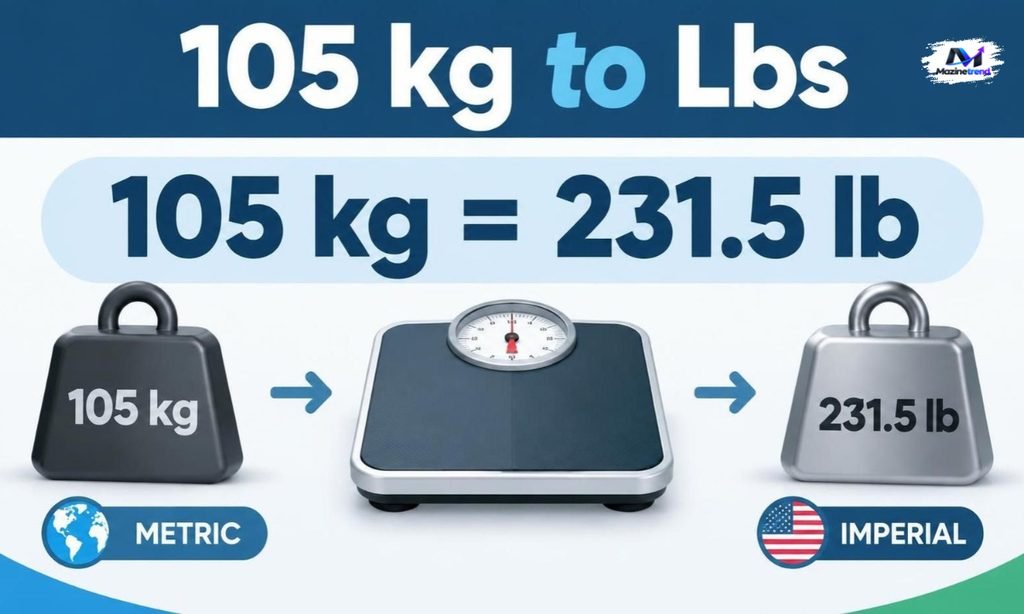
105 × 2.20462262 = 231.49 lbs
In stone, that is 16 stone 7.5 pounds. So 105 kg is about 2.2 pounds lighter than 106 kg.
106 Weight in Pounds
If you searched for “106 weight in pounds,” you may have meant one of two things, so here are both.
- 106 kilograms in pounds: 233.69 lbs
- 106 pounds in kilograms: 106 × 0.45359237 = 48.08 kg
The second one is a very different number. A weight of 106 pounds is about 7 stone 8 pounds. Always check which unit your source is using before you act on the number, especially for medication doses, shipping costs, or fitness goals.
FAQs
How many pounds is 106 kg?
106 kg is 233.69 pounds. Rounded, that is 233.7 lbs, or 234 lbs for a whole number.
What is 106 kg in stone and pounds?
106 kg is 16 stone 9.7 pounds. Many people round this to 16 stone 10 pounds.
Is 106 kg overweight?
For most adults, yes. The exact category depends on your height. At 190 cm (6 ft 3 in), 106 kg gives a BMI of 29.4, which is in the overweight range. At 170 cm (5 ft 7 in), the BMI is 36.7, which is in obesity class 2. If you are very muscular, BMI may overstate your body fat, so ask a doctor to look at your waist size and blood tests as well.
How do I convert 233.7 lbs to kg?
Multiply 233.7 by 0.45359237. The answer is about 106.0 kg. You can also divide by 2.20462 and get the same result.
What is the easiest way to convert kg to lbs without a calculator?
Double the kilograms and add 10% of the kilograms. For 106 kg, that is 212 plus about 10.6, which gives roughly 223, then add a few more pounds for accuracy. It gets you close enough for everyday use, though the exact answer is 233.69.
Final Thoughts
So, 106 kg is 233.69 pounds, or 16 stone 9.7 pounds. The key number to remember is 2.20462, the amount of pounds in one kilogram. With it, you can convert any weight on your phone in a few seconds.
If you are checking this number because of your health, remember that the scale is only one piece of the picture. Height, muscle, waist size, and blood tests all matter. A short chat with your doctor will tell you more than any chart can.
Got a different weight to convert? Try the same formula with your own number, and keep the chart above handy for nearby values.

Smith Oxford is the administrator of MagzineTrend, bringing over five years of SEO experience to the website. He oversees content quality, search optimization, and site updates, helping readers discover practical measurement guides and engaging celebrity features.